My personal reflection for Easter week

For most of my life I worked, I looked after my kids, I caught the bus. Mostly mundane things. But once in a while something happens that lodges in you permanently — like a splinter of cobblestone you can’t shake from your shoe. For me, that thing was Jerusalem.
It is Easter week again, and I keep going back there in my head. This year, the Holy Places are closed to most worshippers — Iran has been targeting Jerusalem with missiles, and it took considerable effort and determination by church authorities to have the sites opened even for priests to celebrate services. The public cannot enter. The Church of the Holy Sepulchre, the Via Dolorosa, the Garden of Gethsemane — places that are normally packed and noisy and gloriously, stubbornly alive with pilgrims from every corner of the world — are quiet in a way they have rarely been quiet in two thousand years of continuous worship.
I find that almost unbearable to imagine. So let me tell you what those places felt like when I walked them. Because they are real, and they deserve to be remembered as real — not just as names in headlines, but as stones underfoot and cold air in a chapel and three nuns racing up a staircase.


The Chapel of the Whipping
At the second station on the Via Dolorosa there are two chapels, and I ducked into the Chapel of the Flagellation to wait for the procession. It was unearthly cold — the kind of cold that has nothing to do with the weather outside, that seems to come from the stones themselves. I lasted about two minutes before my usual sneezing fit started and I had to retreat into the Jerusalem sunshine. But before I left I noticed something in the corner: a game like noughts and crosses, carved crudely into a flagstone. Roman soldiers scratched it there, presumably to pass the time. This was the courtyard where Jesus was stripped and whipped, and someone had been bored enough to carve a game. The mundane and the momentous, occupying exactly the same stone. Jerusalem is full of that.
The Handprint
Further along, at the fifth station, there is a hollow in the wall where tradition says Jesus rested his hand. It is worn so smooth now — by so many millions of hands over so many centuries — that you can no longer touch it. You can only look at it. There is a barrier, and you stand before it, and you look.
I find that oddly more powerful, not less. The hollow is there because of accumulated devotion. Human longing wore it out. It crossed a threshold from relic into something more fragile — something that now has to be protected from the very love that created it. There’s a whole theology in that, if you want one.
My feet and legs were aching, my ankles twisted frequently on the picturesque cobblestones — and yes, my heart was full of joy as I entered each holy place.
Follow those Nuns!
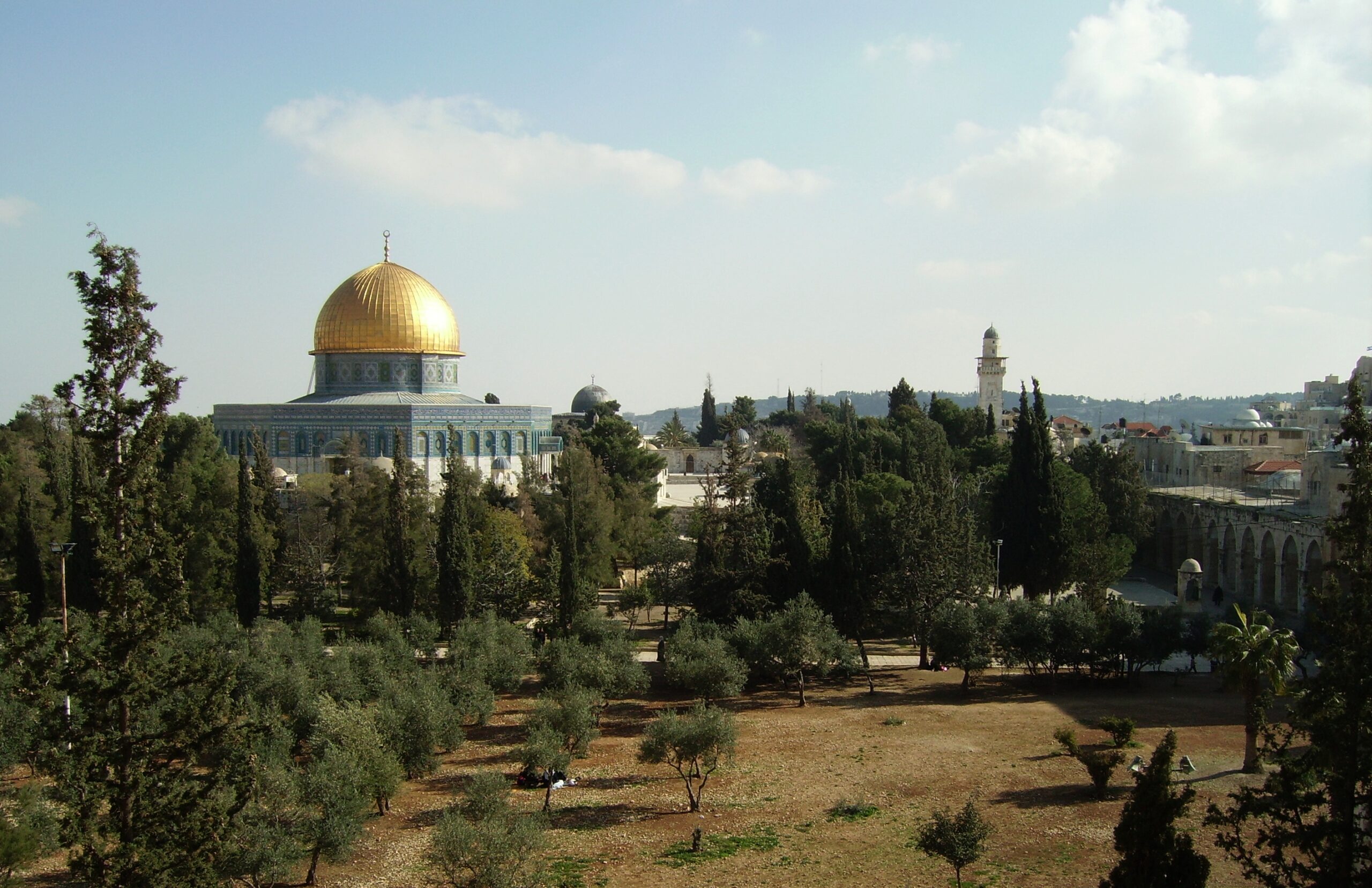
Jerusalem teaches you to follow your instincts — and occasionally, to follow complete strangers. On the Friday I spotted three nuns from Mother Teresa’s Missionaries of Charity racing up a flight of stairs with most un-nunnish speed, calling excitedly to each other. I did what any sensible pilgrim would do: I followed them. At the top, I got my first and closest view of the Dome of the Rock, looking westward from the east — the Dome magnificent and gleaming, the gardens around it rather less so, nothing at all like the Mughal gardens of Kashmir. But the Dome itself — yes. Worth every stair, and worth following three excited nuns to find it.
The Temple Mount itself was closed to non-Muslims that weekend, being Shabbat. The closest I got was the Western Wall below — no cameras, no phones allowed. A friend had suggested I sneak a photo on my phone. I did not. Some prohibitions feel right to observe, even when you could get away with breaking them.

Gethsemane
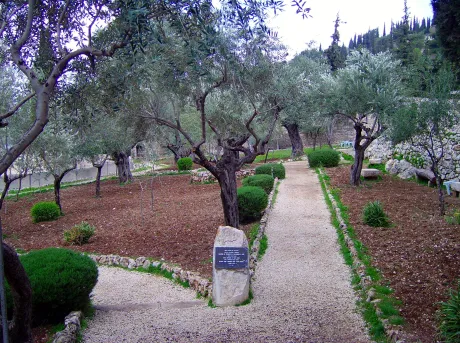
The garden is not grim, the way Mel Gibson would have you think. In spring sunlight, the churches there gleam and flash — golden onion domes above, the magnificent facade of the Church of All Nations below. I had imagined darkness and dread. Instead I found a park where you could rest after the heat and dust of the city, with old olive trees that are genuinely, verifiably ancient. They were there. The biology and the theology simply overlap, and you don’t have to resolve the tension.
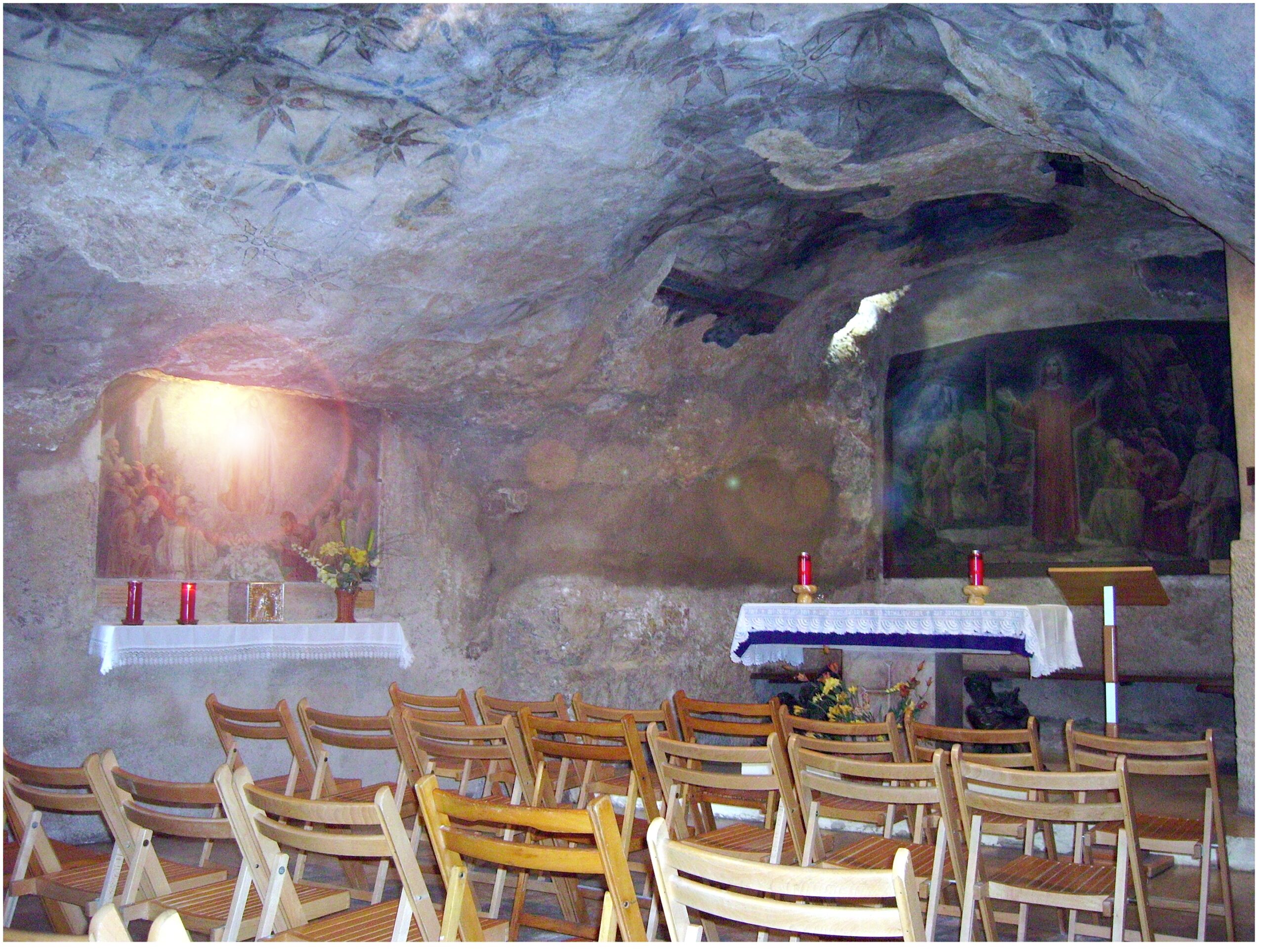
There is a grotto too — quieter than anything else I found in Jerusalem. A narrow sun-baked corridor, artwork on the ceiling, a small chapel at the end. A taxi driver told me to go there first. I almost didn’t listen. I’m glad I did. I think about that a lot now when I’m coaching writers: the people on the ground usually know something the map doesn’t.
Church of the Holy Sepulchre
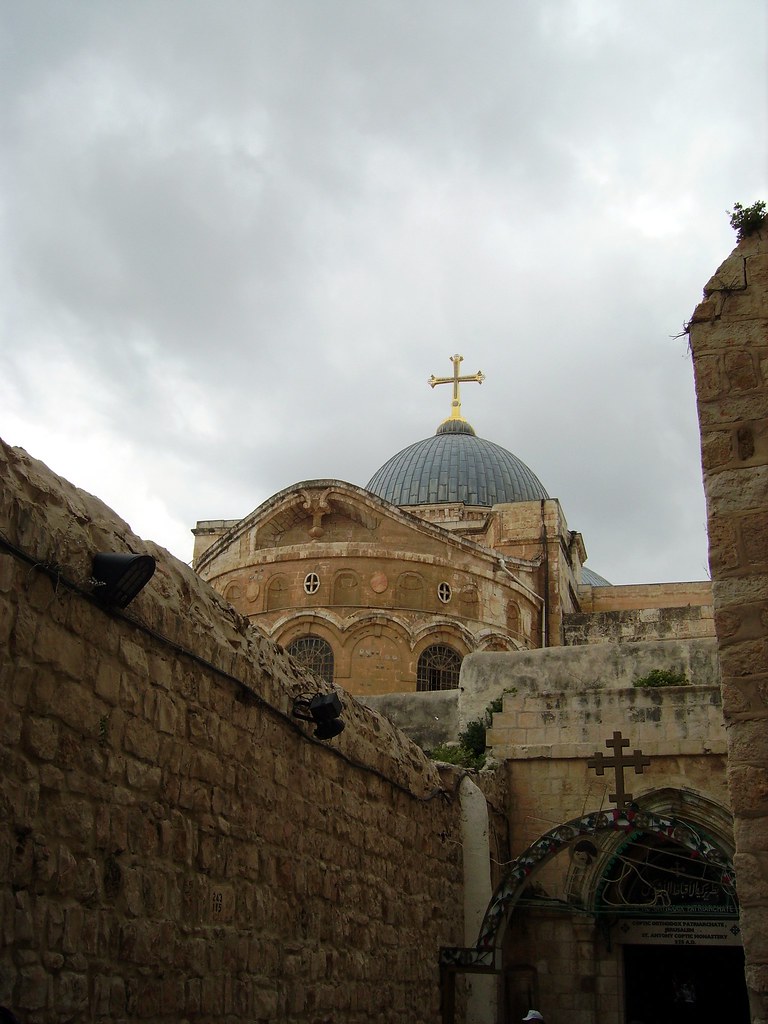
The Church of the Holy Sepulchre is huge, dark, and not at all what you expect — no clean lines or contemplative hush. It’s robust, muscular, crowded, contested, beautiful. The stairs to Golgotha are worn so smooth I had to grip the rail. In the tomb itself — tiny, holding maybe five people — you get a moment, just a moment to touch the stone, and then the Orthodox heavies move you along. I had no complaint. You don’t need long. You just need to be there once.
I didn’t take photos during the Stations of the Cross on the Friday afternoon. A camera felt like the wrong tool for that particular kind of attention. Some things need to be received without the instinct to document. I say this as someone who now earns a living from words — there are moments that resist capture, and the right response is simply to be in them.
This Easter, those same Stations are being walked by priests alone. The crowds of ordinary folk from every part of the world — the nuns and the pilgrims and the Russians cutting the queue and the woman selling fresh greens at the station where Veronica wiped the face of Jesus — are absent. It took real determination by church leaders just to get the doors open for clergy. The public remains outside. I cannot quite take that in.
What does all of this have to do with now — with this Easter, this grandchild to be collected from her other home, this garden that refuses to wait, this manuscript someone is trusting me to help them finish?
Everything, I think. The Jerusalem I walked was a safe, warm, astonishingly friendly place — full of ordinary people going about ordinary lives between extraordinary stones. That place is still real, even when missiles make it unreachable and headlines make it unrecognisable. The priests celebrating Easter in those emptied churches this week are holding something on behalf of all of us who have been there, and all of us who hoped one day to go.
That hollow in the stone at the fifth station — worn past touching now, reduced to something you can only witness — keeps coming back to me. And so does that soldiers’ game scratched into the flagstone, and three nuns in white and blue saris sprinting up a staircase. The sacred and the absurd, constantly overlapping. That’s Jerusalem. That’s also, if I’m honest, most of a life of faith.
It’s a real place, with real people, real history, and real problems — and somehow, stubbornly, it is warm and full of grace.
So this Easter I’ll say my prayers in my ordinary faraway suburb, light a candle in a perfectly normal parish, and probably also weed something and feed someone. I’ll pray for Jerusalem — for the priests marking Easter in near-empty churches, for the city’s people, for some kind of peace that currently feels very far away. And I’ll carry the memory of those steep hills, those worn stones, that cold little chapel, those sprinting nuns. The places stayed. It is enough.